
Background:
Eczema is that one clingy friend who always crashes your party. It shows up unannounced and messes with your plans by staying way too long, making a scene and ensuring everyone gives it attention. All jokes aside, eczema is a chronic inflammatory condition of skin that negatively impacts millions of people around the world with flakiness, itchiness, irritation, inflammation and downgrading all victim’s self esteem and damaging quality of life.
The big picture from all of the studies that are mentioned below is a solid indication that eczema is not just one simple problem. It is a problem that overlaps with many aspects of life such as aging, immune function and microbial communities.
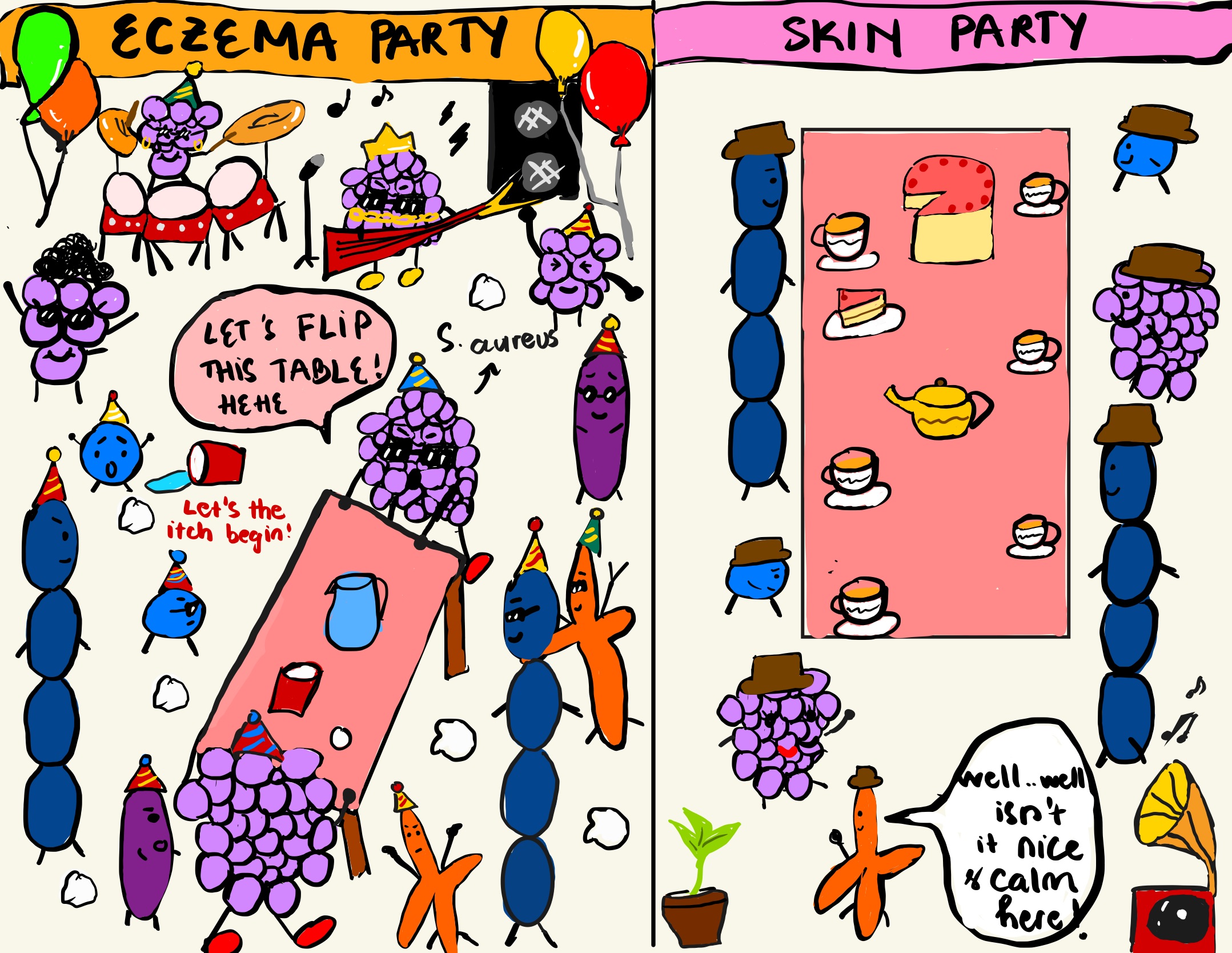
Early research that focuses on skin microbiome – the complicated network of bacteria and other microorganisms which live on our skins – has given eczema the spotlight due to its disruption to the skin ecosystem. Marrs and Flohr (2016) were one of researchers who showed interest in solving the microbiome relation to eczema. Their study found that eczema patients tend to have lower skin microbial diversity- fewer microbial “guests” attending the skin party compared to the healthy individual. This distinct difference in microbial balance created an ideal opportunity for Staphylococcus aureus – one of the rebellious guests that takes over the skin party and stirs up the inflammation.
However, microbes don’t just thrive in isolation from the world, factors such as age influences all of the possible shifts . Towsend and Kalan (2023) revisit the topic with us that skin microbiome is a dynamic ecosystem that could develop gradually across our lifespan. While simple, fast- changing microbial communities dominate in baby’s skin, a more complicated, oil- loving population are more involved in teenage and adult skin. Understandably, aging eventually leaves our skin thinner, drier and less oily. This implies that skin communities shift and change over our lifetime as we age. Therefore, the magnitude of differences in skin communities of elders skin and young adults are immense.
In order to dive deeper in this concept, Woo and Kim (2024) investigated the correlation between aging skin barrier and the skin microbiota. Skin barriers are weakened as we age due to the loss of lipid, moisture and certain structural proteins which also influences the shift on skin microbes. Interestingly, they also explored the relation between skin and gut microbiota, suggesting that there is a link between age- related gut imbalance in the intestine potentially promote compilation to others skin problems such as acne, eczema, psoriasis and rosacea (Woo & Kim, 2024).
Altogether, these studies suggested that eczema is indeed a complicated problem which include many factors alongside such as aging, immune function and skin microbial imbalance. Marrs and Flohr (2016) opened the story with microbiome plays an important role in development of eczema. Townsend and Kalan (2023) continued the story by reminding us how our skin’s microbial shift as we age-baby skin has simpler guest lists while adult skin hosts more complicated, oil-loving guests . Last but not least, Woo and Kim (2024) pointed out that shifts in barrier and microbiome aging are not only the victims of time, but also play an active role in the eczema drama. The inflammation and barrier destruction perhaps are driven by the imbalance in the microbial system. As a result, older skin is more fragile and prone to risk of decreasing in health and balance across all layers, making it easier for rebellious guests to cause a scene at the skin party.
Nevertheless, one of the outstanding questions in this big picture holds out: Is the same microbial fingerprint shared across all eczema patients, or does it different with age?
Central question:
Do all eczema victims share the same microbial characteristics? Particularly, how different is the skin microbiome of elderly patients from the younger ones? Furthermore, could these differences address the different behavior of eczema in older skin. In order to dive deeper in those questions, Dong et al. (2025) research distinctively chose to investigate the differences between elderly and younger eczema sites in order to distinguish unique characteristics of this disease in the elderly population.
Evidence:
Dong et al. (2025) performed a multi-perspective analysis of the skin microbiota in both elderly and young patients. The study compared the skin microbiota of younger (below 60 years old) and older (above 60 years old) eczema patients by gathering samples from lesion site and non lesion site of each patient, then for the purpose of identifying “who is there”, researchers extracted bacterial DNA and carried out 16S rRNA gene sequencing which is a way to check identification of bacteria who were attending the skin party. Using the information they discovered, differences in eczema were analyzed by several factors such as which bacteria reside on the skin, which types were more or less common, if one group was ruling over the others and if certain groups pop up more than the other when eczema was worse (Dong et al., 2025).
One of the key findings in this research was that both younger and older eczema patients’ skin communities are less balanced (lower microbial diversity) compared to healthy skin control groups which means that their skin parties have fewer guests attending than regular skin parties. Both older and younger eczema lesion sites had noticeably decreased diversity in the microbial communities compared to their healthy skin sites (non lesion sites). This suggests that regardless of age, eczema surely does interrupt skin’s balance. However, their party guests are more chaotic than the healthy skin party. Instead of a calm quiet “classical music party”, eczema hosts a “hard rock party” with lots of screaming.
Interestingly, eczema patients across all ages hosted the same party guests including big bacterial families such as Actinobacteria, Firmicutes, and Proteobacteria. Imagine them as the regular guests that always show up at the skin party. In both older and younger patients, when eczema hosts a big and chaotic party, Staphylococcus aureus often show up as a loud troublemakers who crashes the party, stirs up the drama and flips the balance table. In the study by Dong et al. (2025), high amounts of Staphylococcus species were detected on lesion sites of eczema patients, especially in elderly patients, suggesting that this microbe plays a critical role in worsening inflammation and flare-ups which cause the party to go south – though it may not be the only culprit. This lines up with earlier research showing that S. aureus releases toxins which vandalize the barrier of the skin and provoke inflammation (Marrs & Flohr, 2016).
(Figure 1).
Moreover, the researchers discovered more mixed bacteria guests in older patients than younger patients. While younger patients had pleasant feast from Cutibacterium who is a friendly and well-behaved bacteria that keep the party atmosphere calm and balanced, older patients skin parties have newcomers who might misbehave and cause chaos such as Paracoccus, Deinococcus, Kaistella, Escherichia, and Chryseobacterium. Among these infamous guests, Kaistella was suspected to be the biggest party crasher, who frequently attended the severe eczema event especially in elderly patients (Dong et al., 2025). These newcomers occurred to enjoy the skin parties from the elderly patients the most due to their declining and drier skin condition, which can be an explanation why eczema in older patients can be persistent and more severe.
Long story short, Dong and colleagues (2025) share that while eczema turns the skin “classical music party” to a “hard rock party”, aging skin switches the guest lists furthermore. Due to declining skin health in our senior population, which offer a drier, thinner and weaker barrier for the infamous guests of microbes to crash and take lead of the party.
Questions:
These findings from Dong et al. (2025) opened multiple doors to encourage for further research that worth investigating:
As skin ages, skin health declines. It is prone to vulnerability due to the loss of diversity in the microbial communities. It is also thinner, drier and has a weaker barrier which might influence the party and makes it easier for certain bacteria to sneak in. What exact conditions allow these uninvited guests to grow and thrive, causing disturbance in elderly patients?
We are all aware that S. aureus is suspected to be the main troublemaker at the eczema parties. However, there are potentially different versions of S. aureus. Perhaps the strains which were found in elderly patients have other tricks or features that drive the inflammation more intensely in elderly patients than young patients?
The newcomer Kaistella majorly crashed at elderly eczema parties and is suspected to cause worse symptoms. What are the special factors and substances that Kaistella produced that directly link to the inflammatory response and disrupted barrier in elderly eczema?
If certain bacteria are only caught to cause problems in elderly patients’ skin, could future treatments focus on targeting those specific bad guys to help clean up the party instead of using cookie-cutter therapies?
Further Reading:
The role of skin and gut microbiota in the development of atopic eczema
Scientists have looked into the skin microbiome’s starring role in eczema even before this. This study from Marrs and Flohr (2016) has found that Staphylococcus aureus doesn’t just hang around during flare parties but may actively cause drama by vandalising the skin barrier and stirring up inflammation-making it a true ringleader in eczema.
Interaction between the microbiota and the skin barrier in aging skin: a comprehensive review
Another inclusive review of aging skin from Woo and Kim (2024) highlights how the gut-skin connection comes into play: it addresses how skin and gut microbiota shift with age, addresses how these changes can damage the skin barrier and suggests interventions that might help target the gut-skin axis.
The dynamic balance of the skin microbiome across the lifespan
A broader picture of the skin microbiome must be addressed to enhance an understanding that is beyond this comparative study. In this paper, Towsend and Kalan (2023) discusses how age, inflammation and microbial metabolites interact and suggests various ways the aging microbiome may affect the skin barrier and inflammatory pathways.
References:
Dong, D., Wu, Q., Wang, Z., Xu, P., Zhu, T., Yang, T., Gu, Z., Zhang, L., & Guo, Z. (2025). Multi-perspective analysis of skin microbiota in elderly eczema patients. PLoS ONE, 20(3), e0318240. https://doi.org/10.1371/journal.pone.0318240
Marrs, T., & Flohr, C. (2016). The role of skin and gut microbiota in the development of atopic eczema. British Journal of Dermatology, 175(Suppl 2), 13–18. https://doi.org/10.1111/bjd.14907 PubMed+1
Townsend, E. C., & Kalan, L. R. (2023). The dynamic balance of the skin microbiome across the lifespan. Biochemical Society Transactions, 51(1), 71–86. https://doi.org/10.1042/BST20220216 PubMed
Woo, Y. R., & Kim, H. S. (2024). Interaction between the microbiota and the skin barrier in aging skin: a comprehensive review. Frontiers in Physiology, 15. https://doi.org/10.3389/fphys.2024.1322205