
Background
The human body is full of microbial ecosystems: tiny communities of bacteria, fungi, and viruses that live on and inside of us. The vaginal microbiome (VMB) is a community of these microorganisms that play an important role in women’s health and reproduction.
A healthy vaginal environment is usually dominated by Lactobacillus bacteria. These microbes produce lactic acid, which keeps the vaginal pH low (around 4.5). This acidic condition works like a built-in defense system to help protect against infections. When this balance changes and Lactobacillus levels drop, other bacteria can take over. This imbalance, called dysbiosis, often leads to bacterial vaginosis (BV). BV happens when there are fewer Lactobacillus bacteria and more growth of Gardnerella vaginalis, a bacterium linked to imbalance.
BV is linked to a higher risk of sexually transmitted infections (STIs), pelvic inflammatory disease, and preterm birth. Low levels of Lactobacillus crispatus and high levels of BV-associated bacteria like Lachnospiracease BVAB1 (Candidatus Lachnocurva vaginae) and Sneathia amnii are linked to an increased risk of preterm birth (Fettweis et al., 2019).
Scientists organize vaginal microbiomes into groups called Community State Types (CSTs). Early research identified five main CSTs: four dominated by different Lactobacillus species (CST Ⅰ, Ⅱ, Ⅲ, and Ⅴ) and one more diverse group containing other bacteria like Prevotella, Gardnerella, and Atopobium (CST Ⅳ) (Ravel et al., 2010). Because each study used slightly different methods, comparing results was difficult. To solve this, France et al., (2020) created a system called VALENCIA, which classifies vaginal communities into 13 subtypes using a consistent reference set. However, new evidence suggests that CSTs might exist on a continuous spectrum rather than in completely separate categories (Lebeer et al., 2023).
CST patterns also differ among populations. Studies show that Lactobacillus-dominated microbiomes are less common in Black (61.9%) and Hispanic (59.6%) women than in Asian (80.2%) and White (89.7%) women (Ravel et al., 2010). These differences suggest that diverse microbial communities may represent a normal, healthy state for some groups (Fettweis et al., 2019; Ravel et al., 2010). Age, childbirth, and menstrual cycle also influence the vaginal microbiome (Lebeer et al., 2023).
Central Question
The researchers wanted to know: Which factors, such as hormones, age, lifestyle choices (e.g. exercise or childbirth history), or environmental conditions (e.g. climate or geography), have the strongest influence on vaginal microbiome composition? And how do different microbial composition types connect to reproductive outcomes like pregnancy success?
Evidence
To tackle these questions, Qin et al., (2025) analyzed vaginal microbiome data from 6,755 Chinese women. Each participant’s microbial profile was matched against 81 possible influencing factors. These included biological markers (such as hormone level), lifestyle factors (such as sexual activity and exercise), and external environmental conditions (such as the season and city of residence).
Utilizing 16S rRNA sequencing (a method that identifies bacteria by reading part of their genetic code), four species were identified nearly universally across participants: Lactobacillus crispatus, Lactobacillus iners, Gardnerella vaginalis (often associated with BV), and Ureaplasma parvum (potentially pathogenic).
L. crispatus and L. iners help keep the vaginal environment stable and healthy, while G. vaginalis and U. parvum can disrupt this balance and increase the risk of infection when they become too common.
Of the 81 possible influencing factors, vaginal dysbiosis showed the strongest impact on vaginal microbiome composition and diversity. When dysbiosis occurs, it reshapes which microbes are present, leading to higher microbial diversity within the vagina. BV, a major indicator of vaginal dysbiosis, reflects an extreme shift from beneficial species to more harmful species and accounts for about 6% of the variation in microbial composition. This seems modest but compared to other factors that typically accounted for less than a 1% difference, this highlights BV as a major driver of microbial imbalance.
The study also found that lifestyle and environment play bigger roles than many expected. Exercise frequency, sexual activity, and pregnancy delivery mode all shaped the vaginal microbiome. Women who exercised more or were more sexually active had higher microbial diversity (alpha diversity) and distinct microbial communities (beta diversity). Women who had given birth also showed higher diversity but lower levels of potentially harmful bacteria. Even uncontrollable factors like the month when the sample was collected or the participant’s city influenced which bacteria thrived.
The researchers discovered that age is not just a gradual influence, instead it has a sharp turning point. Around age 45, protective bacteria (L. crispatus and L. iners) decline significantly, while harmful bacteria such as G. vaginalis and Fannyhessea vaginae increase. Interestingly, this shift happens earlier than the major hormonal changes of menopause. The average age that menopause begins in Chinese women is about 49 years.
Finally, the study classified women’s vaginal microbiomes into 13 “Vagitypes”. Each Vagitype represented a different balance of species. They found that these categories were not only descriptive, but were predictive of health outcomes. For example, among women undergoing in vitro fertilization (IVF) those with Vagitype Ⅴ, dominated by Lactobacillus jensenii, had the highest live birth rate (59.09%) and those with Vagitype Ⅶ, dominated by the BV-associated F. vaginae, had the lowest live birth rate (21.43%) (Figure 1).
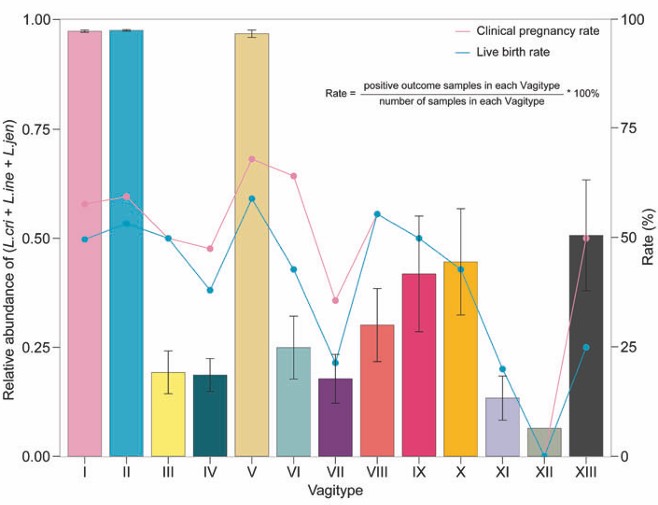
This means Vagitypes offer a much more precise diagnostic tool than traditional microscopy based BV tests which only look at bacterial shape under a microscope. Instead, Vagitypes reveal which species dominate and how that dominance connects to clinical outcomes.
Future Inquiry
- Around age 45 (occurring earlier than major hormonal changes), women experience a sharp decline in protective bacteria species and a rise in harmful ones; what biological or environmental factors drive this abrupt vaginal microbiome shift?
- This study used 16S rRNA sequencing, while powerful, it misses other microbial organisms such as fungi and viruses. Using shotgun metagenomics (with viral enrichment techniques) and ITS sequencing would allow researchers to see the genetic capabilities of all microorganisms present. This could provide a comprehensive view of the vaginal microbiome outside of only bacterial species.
- Since certain Vagitypes are linked to better pregnancy outcomes, can doctors help women “shift” into these categories before IVF or pregnancy attempts? Research into customized probiotics, vaginal microbiome transplants, or synthetic bacterial communities could transform reproductive medicine.
Further Reading
Here are a few key studies that set the stage for this work:
- Ravel et al. (2010): Defined the first major microbial community types in the vagina and laid the foundation for the concept of Vagitypes.
- France et al. (2020): Developed the VALENCIA method, a computational tool to classify vaginal communities with high precision.
- Leeber et al. (2023): Conducted a large scale European study that showed how the vaginal microbiome varies across populations and environments.
- Fettweis et al. (2019): Linked the vaginal microbiome to preterm birth risk and showed its clinical importance beyond fertility treatments.
References
Fettweis, J. M. et al. The vaginal microbiome and preterm birth. Nat. Med. 25, 1012–1021 (2019). DOI: https://doi.org/10.1038/s41591-019-0450-2
France, M. T. et al. VALENCIA: a nearest centroid classification method for vaginal microbial communities based on composition. Microbiome 8, 166 (2020). DOI: https://doi.org/10.1186/s40168-020-00934-6
Lebeer, S. et al. A citizen-science-enabled catalogue of the vaginal microbiome and associated factors. Nat. Microbiol. 8, 2183–2195 (2023). DOI: https://doi.org/10.1038/s41564-023-01500-0
Ravel, J. et al. Vaginal microbiome of reproductive-age women. Proc. Natl Acad. Sci. USA 108, 4680–4687 (2010). DOI: https://doi.org/10.1073/pnas.1002611107
Qin, L. et al. Population-level analyses identify host and environmental variables influencing the vaginal microbiome. Signal Transduction and Targeted Therapy 10, 64 (2025). DOI: https://doi.org/10.1038/s41392-025-02152-8