
Background:
Ears are weird. What do you mean these weird fleshy protrusions stick out of our heads and detect sound so we can hear things? There are a lot of different parts that aren’t visible from the outside, and they are all so important, but they aren’t really talked about. Ears in general aren’t really talked about, so the issues that come with them are even less public. Ear infections are actually one of the most common reasons to go to the doctor and get antibiotic treatment (Osguthorpe & Nielson, 2011).
The thing is, otitis (inflammation of the ear, which is often related to ear infections) was always thought to be a lot more common in children. How often do you hear of a parent taking their kid to the doctor because of an ear infection? For some it feels like they go every other week. However, the Center of Disease Control showed during a study they conducted from 2003 to 2007 (Piercefield et al., 2011) that about half of doctors visits of ear infections were for children, and the other half were for adults.
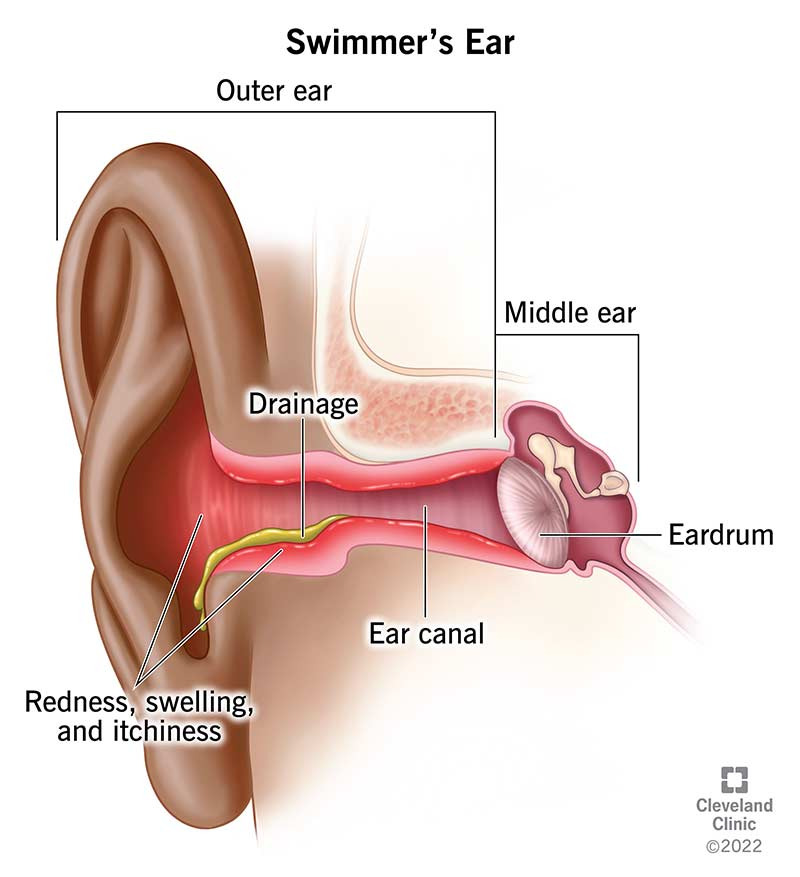
Commonly, ear infections are divided into otitis media and otitis externa (Burton et al., 2022). Otitis media (OM) is infection of the middle ear, while otitis externa (OE) (also called swimmer’s ear) is infection of the outer ear canal. OM causes inflammation of the middle ear with subtympanic fluid accumulation (fluid accumulation in the subtympanic sinus, which is a small recess in the middle ear), causing infection, swelling, redness, and pain. OE consists of outer ear canal infection with inflammation, which then has pain, redness, and tenderness, with purulent extrudates, which is a mix of dead cells, bacteria, and general debris that comes out as a thick, milky fluid. We don’t really know what specific organisms are involved in an ear infection in adults, but what we do know is that there are fungi and bacteria involved in different amounts and in different locations. Some of them need to be cultured in very specific ways for researchers to even be able to tell what we’re looking at in the ears.

The 2022 study by Burton et al. The adult microbiome of healthy and otitis patients: Definition of the core healthy and diseased ear microbiomes, was focused on how a specific gene sequencing technique called Next-Generation Sequencing could be used to shine light on the microbes that live in the ears of an adult both healthy and unhealthy, because the vast majority of the research into ear microbes has used children.
Next-Generation Sequencing:
Next-Generation Sequencing (NGS) is a method of sequencing DNA so we can tell what order the pieces are in in order to identify the chains of DNA. It works by tracking the addition of new, but labeled, nucleotides to a DNA strand that is being copied from a parent strand. NGS is special because it runs thousands of copies at the same time, drastically reducing how much time needs to be spent on sequencing. However, that scale requires a lot of computing power, so only a few labs can run it, and most studies have to outsource their sequencing to another lab, like Illumina.
Central Question:
Overall, the goal was to inspect ear microbes and see how NGS is able to detect the bacteria and fungi that are living in a healthy ear, because if we don’t know what’s in a healthy ear, how will we know what’s not supposed to be there in an infected ear?
Evidence:
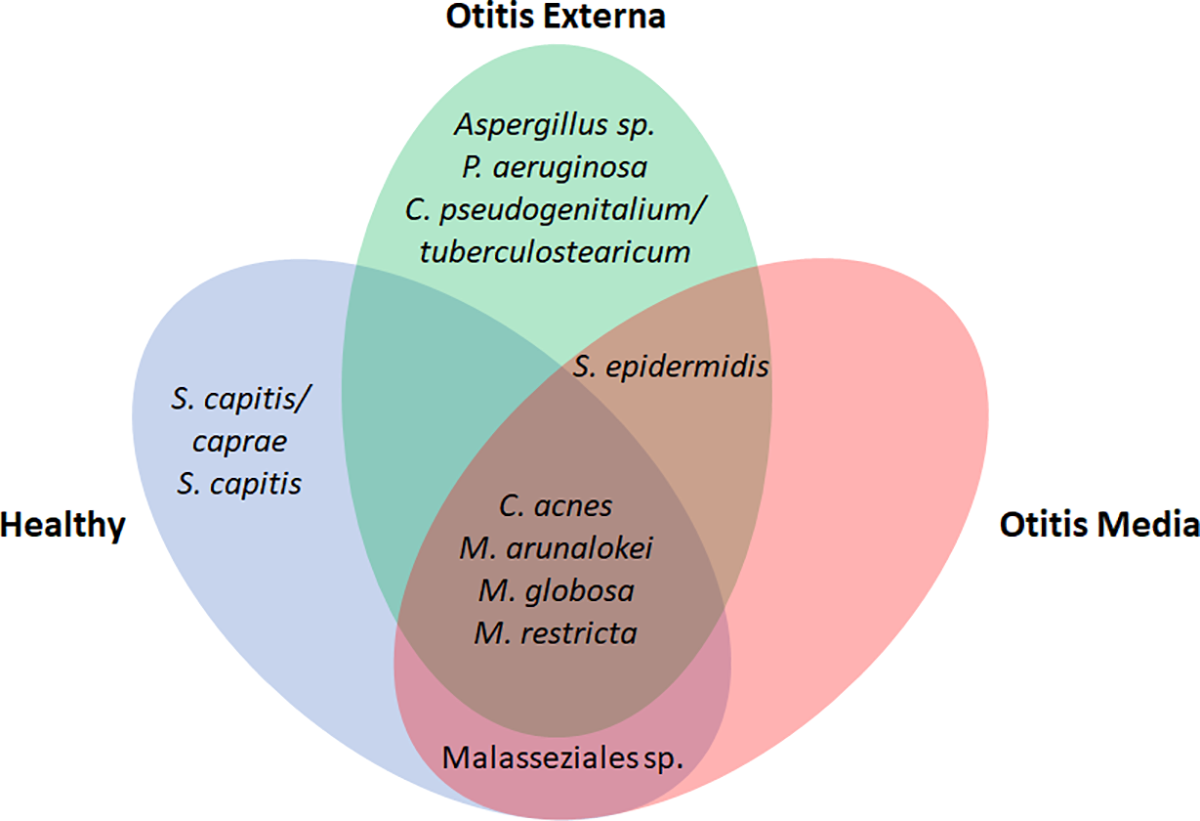
Burton et al. (2022) took samples from each ear of 46 healthy people that had no history of ear infections, nasal cavity infections, and chronic medical conditions, because things can linger, and baselines that have always been healthy are very important. Those samples were compared to the samples of 22 patients with otitis externa and 48 patients with otitis media. The NGS analysis found 877 different bacterial species and 277 different fungal species across all of the samples. Turns out your ears are very crowded dance floors for all of those microbes. Through those samples, they found a large amount of differences between healthy ears and otitis ears.
At a larger scale, healthy ears had a lot of Firmicutes and Actinobacteria, and the otitis ears had Proteobacteria and Bacteroides. Five of the different bacteria species identified had been previously thought to be pathogenic (S. capitis/caprae, C. otitidis, A. otitis, S. caprae, and Streptococcus mitis/oralis/pneumoniae), but they were also found in healthy ears, just at a lower amount. For the otitis ears, there was not a single bacterial species that was found in every single sample. The Protobacterium P. aeruginosa was the most abundant species across both types of otitis ear (Abundancy is a measure of how much there is of one specific thing), but the other most abundant species weren’t identical in each infection type. There wasn’t a significant difference in regards to the number of different species between healthy and otitis ears, but there was a significant difference in regards to the mass of the bacteria, because the otitis ears (both otitis media and otitis externa) had significantly more biomass of bacteria than the healthy ears, which means that there were a lot more bacteria total in the infected ears than the healthy ones.
The fungal analysis gave the same information, that the species found in healthy ears were also found in the otitis ears, just at lower abundances and frequencies. The fungal biomass of the otitis ears was actually lower than the healthy ears, but the number of detected species was significantly increased in the otitis ears compared to the healthy ears (diversity is the measure of amount of species), which means that the amount of fungus in the infected ears was lower than the healthy ones but there was more species of fungus in the infected ears than the healthy ones.. So they were opposites: healthy ears had a lower fungal diversity and a higher fungal biomass as compared to the otitis ears, which is directly opposite the bacterial data, where healthy ears had a higher bacterial diversity and a lower bacterial biomass as compared to the otitis ears.
Conclusions
This study was one of the first to focus on trying to determine what microorganisms are in the ears of an adult, because we just didn’t know what was supposed to be there when an ear infection was occurring and what came from the infection. That is the general thing we need to know when dealing with infections; what microbes are supposed to be there and what aren’t supposed to be there. Different types of sequencing may find different things, and it’s in general really hard to look at fungi and determine what their species is. Too much needs to be followed up on, because a jumping off point can only get you so far.
My Questions
How do ear piercings interact with ear infections? I have multiple piercings in each ear, and they’ve sometimes gotten infected. Sometimes the metal in the piercing will react with the skin of my ears, and I don’t know if that has something to do with my ear infections or if it is just a skin sensitivity.
Do they make them worse or does it really depend on the location? There are some piercings in the ear that get close to the ear canal, and potential infections in a piercing site might transfer into the ear canal later. Those infections might look completely different if they are coming from an outside factor, or if they come from a lobe or helix piercing.
Why do the bacterial and fungal amounts stay in a sort of equilibrium even when the ear is infected? There is really only a limited amount of space in an ear, so maybe they remain in an equilibrium because of the limited resources. But I would think they offer two different niches because they are different microbes, so it doesn’t completely make sense.
Further reading:
The Cleveland Clinic has a pair of pages that go in depth about what otitis media and otitis externa look like and how they are commonly treated. A paper by Akkerman et al. (2005) looks into the over- and under-prescription of antibiotics when dealing with otitis media. This paper by Thorsen et al. (2023) looks into the impact of otitis media with middle ear effusion on the neurological development of children.
References:
Akkerman, A. E., Kuyvenhoven, M. M., van der Wouden, J. C., & Verheij, T. J. (2005). Analysis of under-and overprescribing of antibiotics in acute otitis media in general practice. Journal of Antimicrobial Chemotherapy, 56(3), 569-574. https://doi.org/10.1093/jac/dki257
Burton, M., Krumbeck, J. A., Wu, G., Tang, S., Prem, A., Gupta, A. K., & Dawson Jr, T. L. (2022). The adult microbiome of healthy and otitis patients: Definition of the core healthy and diseased ear microbiomes. PLoS One, 17(1), e0262806. https://doi.org/10.1371/journal.pone.0262806.
Cleveland Clinic. (2025, August 18). Middle ear infection (otitis media): Symptoms, causes & treatment. https://my.clevelandclinic.org/health/diseases/8613-ear-infection-otitis-media link accessed October 30, 2025
Cleveland Clinic. (2024, October 21). Swimmer’s ear (otitis externa): Symptoms, causes & treatment. https://my.clevelandclinic.org/health/diseases/8381-swimmers-ear-otitis-externa link accessed October 30, 2025
Illumina. (2025). Next-generation sequencing (NGS). Explore the technology. https://www.illumina.com/science/technology/next-generation-sequencing.html link accessed October 30, 2025
Osguthorpe, J. D., & Nielsen, D. R. (2011). Otitis externa: review and clinical update. South African Family Practice, 53(3), 223-229. https://doi.org/10.1080/20786204.2011.10874089
Piercefield, E. W., Collier, S. A., Hlavsa, M. C., & Beach, M. J. (2011). Estimated Burden of Acute Otitis Externa–United States, 2003-2007. MMWR: Morbidity & Mortality Weekly Report, 60(19). https://research.ebsco.com/c/u4if57/viewer/pdf/6judcbqxev link accessed October 30, 2025
Thorsen, J., Pedersen, T. M., Mora-Jensen, A. R. C., Bjarnadóttir, E., Bager, S. C., Bisgaard, H., & Stokholm, J. (2023). Middle ear effusion, ventilation tubes and neurological development in childhood. Plos one, 18(1), e0280199. https://doi.org/10.1371/journal.pone.0280199