
Background

The first few months of a baby’s life are the most vital to building their gut microbiome. The establishment of an infant’s gut microbiota, acquired from the mother and the environment, can often have profound long-term effects on their overall health and development, as there is a strong relationship between the early and adult stages (Martínez-Martínez et al. 2024). The gut microbiota comprises all the microorganisms in the digestive tract and often plays a crucial role in the immune system by protecting against other pathogens and maintaining a balanced metabolism (Thursby and Juge et al. 2017).
The World Health Organization (WHO) recommends that mothers exclusively breastfeed infants under 6 months old to ensure their child’s health (Breastfeeding 2023). Breast milk provides a multitude of benefits, including its own microbiota that shapes the beginning of the gut microbiota in infants and provides antibodies to maintain the balance of these microorganisms (Notarbartolo et al. 2022). Breast milk has been shown to promote brain development, as it is associated with higher scores on neurodevelopment and cognition tests later in life (Isaacs et al. 2010). Breast milk also contains many immune cells and antibodies, such as Immunoglobulin A (IgA), that protect against certain diseases (Lokossou et al. 2022). In contrast, most standard infant formula does not contain a microbiota of its own or any additional antibodies (Martínez-Martínez et al. 2024).
While identifying the bacteria present in our gut is useful, it does not fully explain what those bacteria are doing and how this may affect our health. To understand the real impact of gut microbes, the substances that the bacteria produce in the gut can show their respective functions. Volatile organic compounds (VOCs) are chemicals made by gut bacteria, and can provide insight into whether a gut is working in a healthy way or not (Calvo et al. 2024). Some VOCs are harmless, but some are connected to gut inflammation and digestive diseases (Sagar et al. 2015).
To investigate the differences between the two feeding styles on early life development, Martínez-Martínez et al. (2024) conducted a study to determine the impact of breastfeeding, formula feeding, and combined feeding on the gut microbiota of infants by analyzing microbial diversity, VOC output, and IgA levels.
Central Question
How do different methods in early infant feeding impact an infant’s gut microbiome, IgA levels, and production of VOCs? Is it more beneficial for an infant’s development to be breastfed, formula-fed, or a combination of both in relation to their gut microbiome?
Evidence
A cross-sectional study was conducted by Martínez-Martínez et al. (2024) that looked at three cohorts of 55 mother-infant pairs based on whether the infants were breastfed, formula-fed, or a combination of both breast and formula-fed. A cross-sectional observation looks at samples that were collected at a single point in time. To ensure consistency in the participants and mitigate any compounding factors, the selection criteria for infants included: 1 to 6 months old, had not had any solid food, and had gestational ages from 36 weeks to 42 weeks. Fecal samples were collected to compare the microbial diversity through DNA sequencing between the three groups. Production of VOCs and IgA levels were also assessed to determine the impact of breastfeeding, formula feeding, and combined feeding styles.
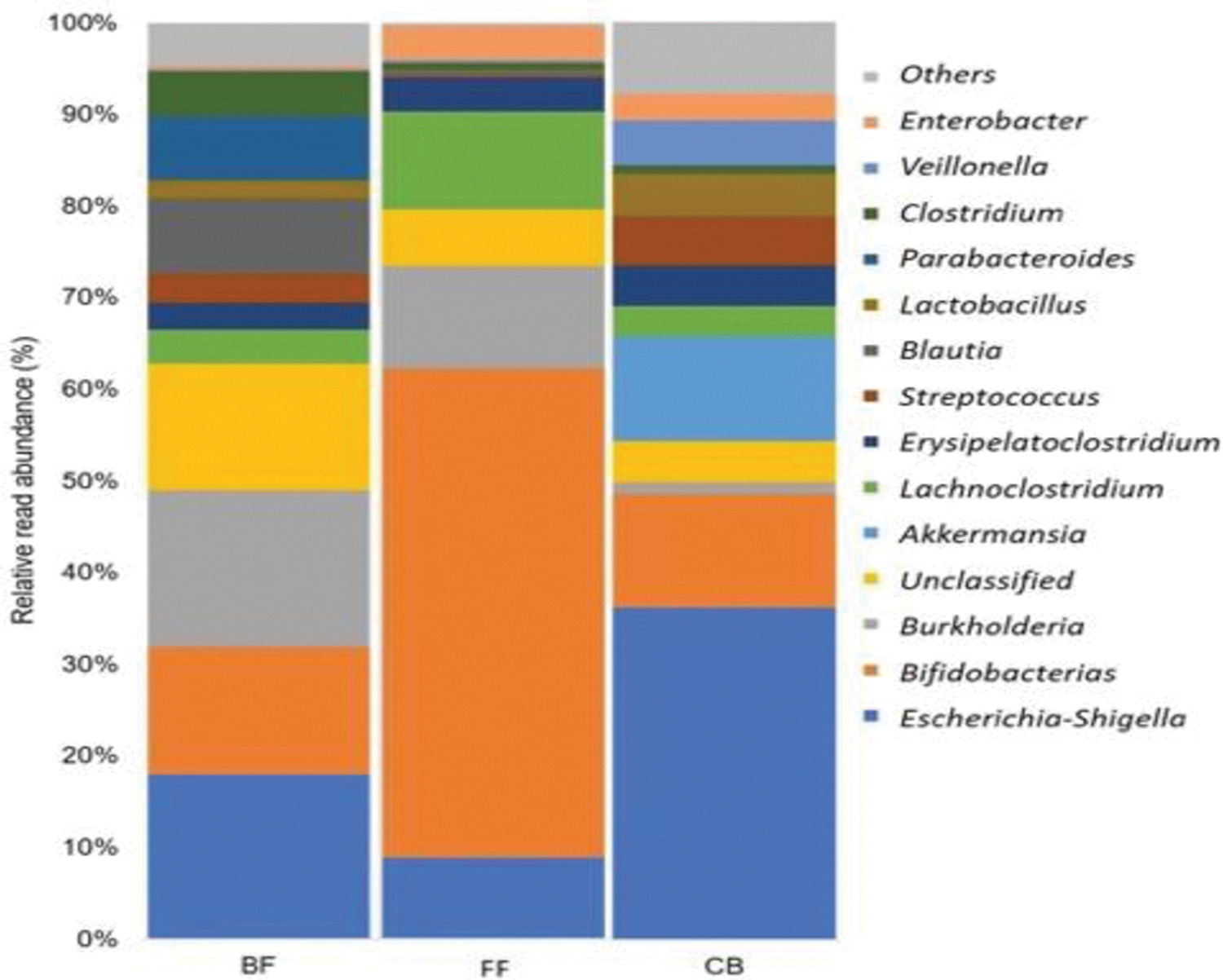
The results showed that there was a difference in the gut microbiota between the breastfeeding, formula feeding, and combined feeding groups (Fig 2). The breastfeeding group was the only group to contain the Blautia species. This species of bacteria is crucial to early life development because it produces compounds that aid in the prevention of chronic diseases related to higher body fat percentage (Vasques et al. 2022). Blautia has been recognized to be negatively associated with certain VOCS, making it a new suggested probiotic strain (Martínez-Martínez et al. 2024). Probiotics are bacteria that are beneficial to one’s gut health by aiding in digestion and immunity.
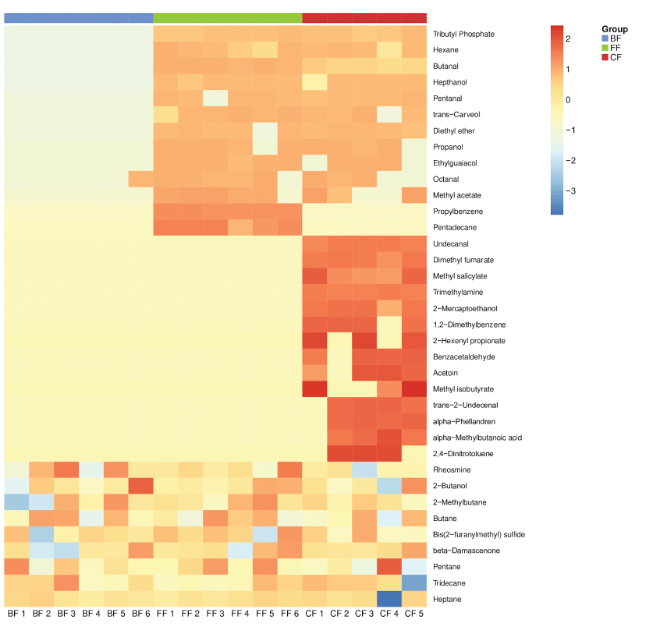
Additionally, the breastfeeding groups were associated with a decrease in specific VOCs (Fig. 3). Most of the breastfeeding group contains an average amount to lower amounts of VOCs. VOCs are byproducts from the gut microbiome and are often used as markers for different gut-related illnesses, as an imbalance can often result in disease (Sagar et al. 2015). This suggests that breastfeeding may have protective measures against these toxic compounds.
Further analysis revealed that differences in IgA levels were significant among the groups. IgA is a type of antibody that helps control the balance of bacteria in the gut, and lower levels of it have been shown to be associated with many microbe-related diseases (Guo et al. 2021). The breastfeeding group displayed twice as many of these antibodies as the formula feeding group, displaying that breastfeeding can impact the gut microbiota and lower the risk of other diseases (Martínez-Martínez et al. 2024).
Future Directions
Even though the study provides substantial evidence on the impact of breastfeeding in early development, researchers in this study acknowledged the sample size limitations, which were only 55 mother-infant pairs and only 18 samples for the VOC analysis. Future studies should incorporate a larger sample size so that the results can be more robust. Larger sample sizes show less variation because they represent the average of a population and mitigate outliers, making the results generalizable and meaningful.
Moreover, this study only obtained one sample from each parent-infant offspring. It would be much more relevant to other researchers and public health experts if multiple samples were collected throughout the infant’s development. This would ensure that any outliers, such as uncontrolled environmental exposures and microbiome fluctuations during the day, would be diminished, and the fecal results would be a better representative of that individual. By tracking the fecal samples throughout the infant’s development, you would also be able to compare the changes in microbial diversity as an infant ages and distinguish whether a result is due to temporary fluctuations or long-term trends. Other studies have implemented this approach. Another study looked at the development of microbiota in the breastmilk and infant and children’s feces by sampling these substances at different points in their lives: 3 months, 18 months, 3 years, and 5 years (Lif Holgerson et al. 2022). This was able to show the progression and diversification of bacteria in the gut.
My Questions
How can future studies establish the link between VOCs and bacteria, given that VOCs can come from bacteria, the environment, or other microorganisms? The study does not discern whether the VOCs may have come from the milk sources or the environment. As a result, it is unclear whether certain infant feeding styles impact the production, reduction, or any benefit regarding VOCs.
Are there better ways to promote greater microbial diversity and antibody levels in other forms of infant feeding styles other than breastfeeding, considering that many parents do not have the capabilities to breastfeed? Investigating whether the addition of probiotics or supplements could mimic the effects of breast milk would be revolutionary.
Further Reading
This paper looks at the gut microbiome of many infants from different environments: industrial, non-industrial, and transitional. It highlights how lifestyle factors shape microbial diversity, and these could influence long-term health.
This paper investigates whether the fetus is exposed to microbes before birth. Readers may find this article interesting because it challenges the established hypothesis that the womb is sterile, and as a result, the first establishment of the infant microbiome is through breast milk and vaginal delivery.
This paper looks at the powerful psychological benefits of breastfeeding in terms of maternal mental health. This may be interesting because it highlights that breastfeeding can also make an impact on the mother instead of just on the infant.
References
Breastfeeding. (2023). World Health Organization. https://www.who.int/health-topics/breastfeeding#tab=tab_1
Calvo, M., Maugeri, G., Migliorisi, G., Scalia, G., & Stefani, S. (2024). The volatile organic compounds detection in MDR Gram-negatives antimicrobial susceptibility testing: Results from a four-month laboratory experience. Diagnostic Microbiology and Infectious Disease, 110(4), 116533. https://doi.org/10.1016/j.diagmicrobio.2024.116533
Guo, J., Ren, C., Han, X., Huang, W., You, Y., & Zhan, J. (2021). Role of IgA in the early-life establishment of the gut microbiota and immunity: Implications for constructing a healthy start. Gut Microbes, 13(1), 1–21. https://doi.org/10.1080/19490976.2021.1908101
Hill, L., Sharma, R., Hart, L., Popov, J., Moshkovich, M., & Pai, N. (2021). The neonatal microbiome in utero and beyond: perinatal influences and long-term impacts. Journal of Laboratory Medicine, 45(6), 275–291. https://doi.org/10.1515/labmed-2021-0131
Isaacs, E. B., Fischl, B. R., Quinn, B. T., Chong, W. K., Gadian, D. G., & Lucas, A. (2010). Impact of Breast Milk on Intelligence Quotient, Brain Size, and White Matter Development. Pediatric Research, 67(4), 357–362. https://doi.org/10.1203/pdr.0b013e3181d026da
Lif Holgerson, P., Esberg, A., West, C. E., & Johansson, I. (2022). The breast milk and childhood gastrointestinal microbiotas and disease outcomes: a longitudinal study. Pediatric Research, 93, 1–9. https://doi.org/10.1038/s41390-022-02328-w
Lokossou, G. A. G., Kouakanou, L., Schumacher, A., & Zenclussen, A. C. (2022). Human breast milk: From food to active immune response with disease protection in infants and mothers. Frontiers in Immunology, 13(849012). https://doi.org/10.3389/fimmu.2022.849012
Martínez-Martínez, M., Martínez-Martínez, M., Soria-Guerra, R., Gamiño-Gutiérrez, S., Senés-Guerrero, C., Santacruz, A., Flores-Ramírez, R., Salazar-Martínez, A., Portales-Pérez, D., Bach, H., & Martínez-Gutiérrez, F. (2024). Influence of feeding practices in the composition and functionality of infant gut microbiota and its relationship with health. PLOS ONE, 19(1), e0294494–e0294494. https://doi.org/10.1371/journal.pone.0294494
Modak, A., Ronghe, V., & Gomase, K. P. (2023). The Psychological Benefits of Breastfeeding: Fostering Maternal Well-Being and Child Development. Cureus, 15(10). https://doi.org/10.7759/cureus.46730
Notarbartolo, V., Giuffrè, M., Montante, C., Corsello, G., & Carta, M. (2022). Composition of Human Breast Milk Microbiota and Its Role in Children’s Health. Pediatric Gastroenterology, Hepatology & Nutrition, 25(3), 194. https://doi.org/10.5223/pghn.2022.25.3.194
Olm, M. R., Dahan, D., Carter, M. M., Merrill, B. D., Yu, F. B., Jain, S., Meng, X., Tripathi, S., Wastyk, H., Neff, N., Holmes, S., Sonnenburg, E. D., Jha, A. R., & Sonnenburg, J. L. (2022). Robust variation in infant gut microbiome assembly across a spectrum of lifestyles. Science, 376(6598), 1220–1223. https://doi.org/10.1126/science.abj2972
Sagar, N. M., Cree, I. A., Covington, J. A., & Arasaradnam, R. P. (2015). The Interplay of the Gut Microbiome, Bile Acids, and Volatile Organic Compounds. Gastroenterology Research and Practice, 2015, 1–6. https://doi.org/10.1155/2015/398585
Stinson, L. F., Boyce, M. C., Payne, M. S., & Keelan, J. A. (2019). The Not-so-Sterile Womb: Evidence That the Human Fetus Is Exposed to Bacteria Prior to Birth. Frontiers in Microbiology, 10. https://doi.org/10.3389/fmicb.2019.01124
Thursby, E., & Juge, N. (2017). Introduction to the Human Gut Microbiota. Biochemical Journal, 474(11), 1823–1836. https://doi.org/10.1042/bcj20160510
Vasques, A., Fernandes, G., Francieli Barreiro Ribeiro, Solar, I., Barbosa, M., Almeida-Pititto, B., Geloneze, B., Ferreria, S., & Freitas, R. (2022). Associations of Blautia Genus With Early-Life Events and Later Phenotype in the NutriHS. 12. https://doi.org/10.3389/fcimb.2022.838750